
Yes, you can see the northern lights in Russia, and the best-known base is Murmansk, a port city in the far northwest. It sits well inside the Arctic Circle, and the aurora season generally runs from late August to mid-April. January to March offers long, dark nights, although cloud cover and weather conditions vary. Before you plan anything, read the entry and safety notes in the “What Should You Know Before Visiting Murmansk?” section. Some Western governments currently advise against travel to Russia.
Can You See the Northern Lights in Russia?
Yes. The aurora appears over Russia’s Arctic and sub-Arctic regions when solar activity and viewing conditions allow. The lights follow a ring around the magnetic pole, called the auroral oval. Parts of northern Russia sit under or near that ring.
Two things limit what you can see:
- Darkness. You need a properly dark sky. In summer, the Arctic sun barely sets, so the viewing season runs from late summer to early spring.
- Clear skies. Clouds can block the lights completely. Weather often affects a trip more than solar activity does.
No operator or guide can promise a sighting. The aurora is a natural event, and responsible tour companies make this clear.
Where Can You See the Northern Lights in Russia?
Murmansk Oblast, on the Kola Peninsula, is one of the most practical choices. It has an airport, railway connections, hotels, and local tour operators that run aurora trips. Murmansk itself lies at roughly 69°N and is often described as the largest city in the world north of the Arctic Circle.
Other parts of Arctic Russia also lie under the auroral zone. These include the Arkhangelsk region, the Yamal Peninsula, Taymyr, Yakutia, and Chukotka. These areas are remote, and few visitors have the time, budget, or logistics to reach them. For most travelers, the Kola Peninsula is the realistic option.
Within the Murmansk region, travelers usually choose from these bases:
| Base | Why choose it | Best for |
| Murmansk city | Airport, train station, hotels, and dark spots near the city, such as Lake Semyonovskoye | First-time visitors and short stays |
| Teriberka | Coastal village on the Barents Sea, about two hours’ drive from Murmansk, with open horizons | Photographers who want a wild landscape |
| Kirovsk and the Khibiny Mountains | Mountain scenery and ski infrastructure, with access through the Khibiny Airport | Active travelers combining skiing with aurora nights |
| Lovozero | Inland village on the tundra, away from city lights | Travelers who want a remote, quiet setting |
Recommendation: For a first trip, base yourself in Murmansk city and take guided evening trips outward. Staying in Teriberka or Kirovsk may suit travelers who have several nights and want to explore more of the region.
What Is the Best Time to See the Northern Lights in Russia?
The best overall period is usually January to March, when nights are long and there is plenty of darkness for viewing. The broader aurora season around Murmansk generally runs from late August to mid-April, but actual viewing conditions depend on cloud cover, darkness, and solar activity.
Each part of the season has a different character:
- Late August to October. Nights become darker, and you may see the aurora in milder weather. Snow can be patchy, and rain or cloud cover may affect visibility.
- November to December. Nights are very long and temperatures fall. Murmansk experiences polar night around the turn of the year, when the sun remains below the horizon for several weeks.
- January to March. Long nights offer plenty of viewing opportunities. Winter activities such as snowmobiling and husky rides may also be available.
- Late March to mid-April. The nights gradually become shorter, but aurora viewing can still be possible while the sky is dark.
Aurora displays can happen at different times of night. Many tours operate in the late evening and around midnight, but there is no guaranteed viewing time.
How Does Solar Cycle 25 Affect Northern Lights Viewing?
Solar Cycle 25 reached its maximum period around 2024–2025. Solar activity changes over time, but the northern lights do not stop appearing simply because a cycle has passed its peak.
For travelers, the practical lesson is to stay flexible. Strong displays depend on geomagnetic activity, while clear skies and darkness are essential for seeing them.
Plan a longer stay rather than a single night. Spending several nights in the region gives you more opportunities to find a combination of suitable weather and aurora activity.
What Are the Chances of Seeing the Northern Lights in Murmansk?
The chances improve when you stay for several nights, but no single night is guaranteed. Murmansk lies close to the auroral oval, so the lights can appear even when solar activity is moderate.
Cloud is a major risk. Murmansk’s coastal climate brings frequent overcast spells, and a clear sky can close in within hours. This is why guided trips often change location during the evening, driving toward clearer skies.
What improves your odds:
- Stay at least four or five nights if your schedule allows.
- Travel during the dark season, particularly January to March.
- Avoid the full moon if possible, as bright moonlight can wash out faint displays.
- Check an official forecast, such as NOAA’s Space Weather Prediction Center, and monitor cloud forecasts as well.
- Stay flexible about your evening plans.
A reliable percentage chance is difficult to provide because the result depends on local weather, solar activity, darkness, and the length of your stay. Treat guaranteed-sighting claims with caution.
What Is a Northern Lights Experience in Murmansk Like?
A typical night mixes waiting with watching. Tours usually leave in the evening and drive away from city lights to a lakeshore, a hilltop, or open tundra. You then stand or sit in the cold, sometimes around a fire or in a heated shelter, while the guide monitors the sky and the forecast.
When the aurora appears, it may start as a faint grey-green arc on the horizon. Some nights it grows into moving bands and curtains; on others, it fades after a few minutes. The naked eye usually sees paler colors than a camera does, so photos can look more vivid than the real sky. Green is common, while purple or red may appear during stronger displays.
The cold is real. Winter temperatures in Murmansk can fall well below freezing, and wind can make it feel colder. Wear thermal layers, insulated boots, a windproof outer layer, and good gloves. Phone and camera batteries drain faster in the cold, so keep spare batteries warm in an inside pocket.
By day, visitors can explore the city’s Arctic attractions and winter activities. Tour offers may include snowmobiling, husky sledding, and visits to coastal villages.
How Does Aurora Hunting in Murmansk Work?
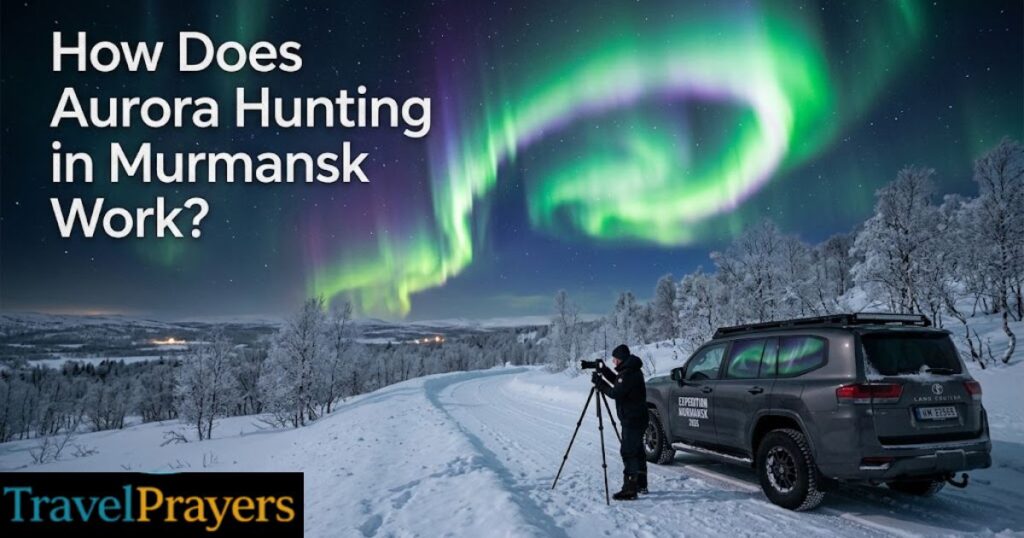
Most travelers go with a local guide or tour operator. A guide knows dark locations, checks weather and aurora forecasts, and drives toward places where the sky looks clearest. You can also go independently if you have a car or suitable transport, but winter roads and extreme cold create additional safety concerns. A guided trip may be the more practical choice.
A typical aurora trip follows these steps:
- The group meets in the early evening, usually at your hotel or an agreed meeting point.
- The guide chooses a location based on cloud cover and the forecast.
- The group drives out, sometimes for 30 minutes to two hours.
- You wait and watch, often late into the evening or around midnight.
- The group returns to Murmansk, usually late at night.
Ask these questions before you book:
- Does the operator move locations if the sky is cloudy?
- Is a heated shelter or warm drinks provided?
- Is the guide English-speaking?
- What is the group size?
- Is there a repeat-trip policy if you see nothing?
Closer spots, such as Lake Semyonovskoye near the city, may work on some nights. When conditions are poor, a guide may travel farther to look for clearer skies.
Tip: Keep your daytime activities flexible. Aurora trips can run late, and you may be tired the next day.
What Should You Know Before Visiting Murmansk for the Northern Lights?
Read this section before you book anything. Travel to Russia carries serious risks that go beyond the cold.
Government travel advice. As of October 2026, the US State Department lists Russia at Level 4: Do Not Travel, and the UK’s Foreign, Commonwealth & Development Office advises against all travel to Russia. Reasons include security risks connected with the war in Ukraine, limited consular assistance, the risk of wrongful detention, and difficulties arranging flights home. Travel insurance may not cover a trip taken against official advice. Check your own government’s latest guidance and your insurer’s terms before committing money.
Check Russia’s Entry Requirements
Entry requirements depend on your nationality, passport, purpose of travel, and intended route. Some travelers may qualify for a Russian electronic visa, while others need a regular visa.
- Check the official Russian Foreign Ministry’s e-visa portal to see whether your nationality is eligible and to review current application requirements.
- Confirm the permitted length of stay and entry conditions for your visa.
- Check whether your intended airport or border crossing accepts your visa type.
- If you are not eligible for an e-visa, contact the relevant Russian embassy or consulate about a regular visa.
- Check passport validity requirements before booking.
Rules can change, so confirm everything through the official portal or your nearest Russian embassy before making travel arrangements.
Getting to Murmansk
Murmansk Airport (MMK) receives domestic flights, including services from Moscow and St Petersburg. Flight times depend on the route and service. Trains are another option, but journeys from major Russian cities can take more than a day.
Traveling to Russia from abroad may be more complicated. Some countries have no direct flights, and restrictions on airspace and airlines can affect routes. Check which connections are operating, confirm your return options, and leave room for disruptions.
A Few Other Things to Keep in Mind
- Payments. Cards issued abroad may not work in Russia. Ask your bank about your card’s restrictions and plan how you will pay for accommodation and tours.
- Phone and data. Consider digital privacy and device security before traveling, and check whether your mobile service will work.
- Clothing. Bring or rent proper winter gear. A standard city coat may not be enough for a night outdoors.
- Daylight. In midwinter, daylight may last only a few hours, and polar night brings a period without sunrise. Plan daytime activities accordingly.
- Language. English may not be widely spoken outside tourist services, so an offline translation app can help.
Plan Your Northern Lights Trip to Russia
For aurora viewing alone, a practical plan is to base yourself in Murmansk, stay four to five nights during the dark season, book guided evening trips, and keep your plans flexible.
Before you commit, work through these questions in order:
- Check your government’s travel advice and your insurance coverage.
- Confirm your visa eligibility and entry requirements.
- Check available flights or trains, return routes, and payment options.
- Compare accommodation and tours, including whether operators change locations when clouds appear.
If travel to Russia is not possible or advisable for you, northern Norway, Finnish Lapland, Sweden, and Iceland also offer opportunities to see the northern lights. The best alternative depends on your budget, flight routes, accommodation, and preferred activities.
You can explore more destination ideas in our TravelPrayers travel guides.
Frequently Asked Questions
Which month is best to see the Northern Lights in Russia?
January to March is a good period because nights are long and dark. September and March can also offer favorable aurora conditions, but clear skies and solar activity matter more than any single month.
Which part of Russia can we see the Northern Lights?
Murmansk and the Kola Peninsula are among the most accessible places for aurora viewing in Russia. Other northern regions, including Yakutia and the Yamal Peninsula, can also experience the aurora but are more remote.
How much does a Northern Lights tour in Murmansk cost?
Published local listings show some group tours at around 4,000–5,000 Russian rubles per person, although prices vary by operator and package. Confirm the current price, inclusions, transport, and cancellation policy before booking.
Which is the cheapest country to see the Northern Lights?
There is no single cheapest country for every traveler because flights, accommodation, transport, and tour prices vary. Compare the total trip cost for destinations such as Finland, Sweden, Norway, and Iceland before deciding.
Is Norway or Iceland better for the Northern Lights?
Both offer excellent opportunities, but neither guarantees a sighting. Norway may suit travelers who want Arctic coastal scenery and winter activities, while Iceland combines aurora viewing with waterfalls, volcanoes, and other natural attractions.
Conclusion
Russia’s Kola Peninsula, especially the Murmansk region, is a notable destination for northern lights viewing. Visit during the dark season, allow several nights for changing weather, dress for Arctic conditions, and choose a tour that can adapt to cloud cover.
Most importantly, check current official travel advice, visa requirements, and transport options before booking. With careful planning and realistic expectations, you can make an informed decision about whether Murmansk is the right aurora destination for your trip.
