
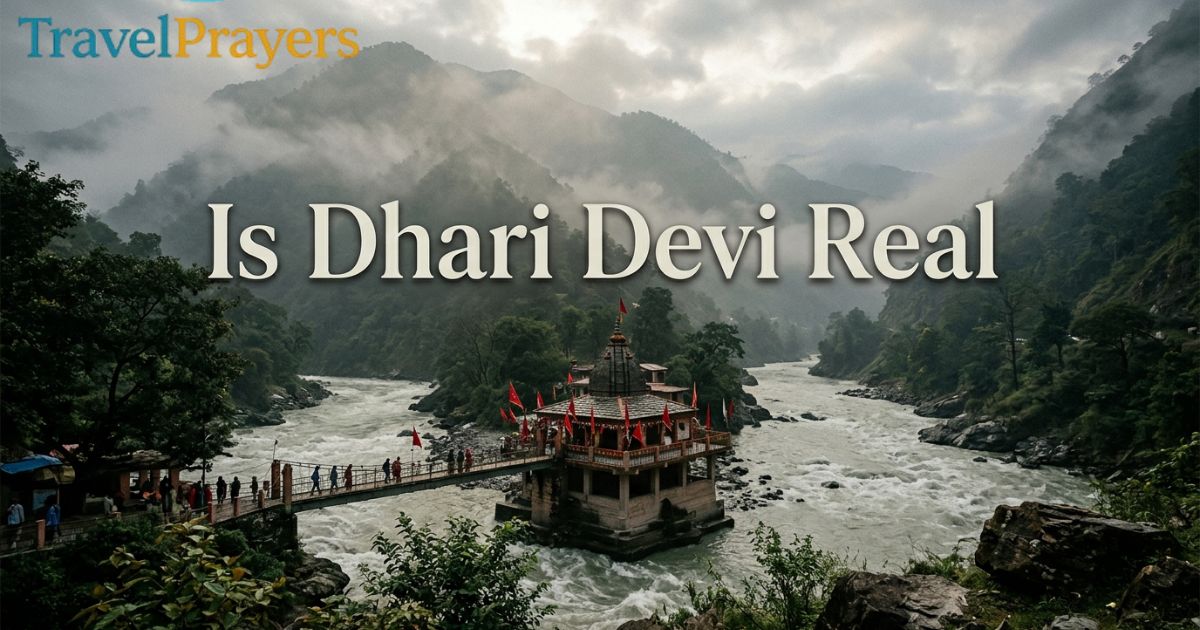
The Dhari Devi temple is real, and you can visit it. It stands at Kalyasaur village on the Alaknanda River, about 14–15 km from Srinagar (Garhwal) and about 20 km from Rudraprayag, on the Rishikesh–Badrinath highway. Devotees worship Dhari Devi as a fierce form of Goddess Kali and as the guardian of Uttarakhand and the Char Dham route. So the answer to “Is Dhari Devi real?” depends on what you mean. The shrine, the worship and the 2013 relocation of the idol are documented. The belief that moving the idol caused the Kedarnath flood is a matter of faith, and the scientific record points to other causes.
This guide separates the two. You will find the history, the legend, the link people draw with the 2013 disaster, what researchers say, and practical details for reaching the temple.
Mystery of Dhari Devi Temple
Three things make this temple stand out.
It sits over the river. Visitors reach the shrine by a short walkway from the highway. The Alaknanda flows right beside it.
The temple has no roof. Devotees say the goddess prefers the open sky. One local account adds that the upper part of the idol stays uncovered even now.
Devotees say the idol changes its face. Locals describe the goddess as a young girl in the morning, a woman at midday and an older woman in the evening. Nobody has verified this, and it remains a matter of devotion.
None of this is scientific fact. It is how generations of Garhwalis describe the place, and it explains why people treat it with deep respect.
Dhari Devi Temple History
Who is Dhari Devi? She is a form of Goddess Kali. A local priest has said the name comes from the village of Dhari, and that the temple is among the oldest Shakti sites in the region. Some accounts say the Pandavas worshipped the goddess during their exile. These are traditions, and no inscription or official record I found confirms them.
The most repeated legend says a flood once washed away an old shrine. The idol caught against a rock in the Alaknanda near Dharo village. A divine voice then told villagers to install her there. That is why the shrine grew up in the middle of the river.
The relocation is the best-documented part of the story. The Srinagar hydroelectric project on the Alaknanda put the old temple site inside the reservoir’s submergence zone. Workers and priests moved the idol onto a raised concrete platform on 16 June 2013. Reports differ on the exact hour, but the evening is the time most often cited. The aim was to protect the idol from submersion. Many locals opposed the move.
Kedarnath Flood and Dhari Devi Connection
Within hours, Kedarnath suffered one of India’s worst disasters. Heavy rain had fallen over Uttarakhand since 14 June, and the heaviest destruction came on 16–17 June. One report puts the toll at roughly 5,700 people dead or presumed dead, and other sources cite higher figures.
People in Garhwal linked the two events. Some say the goddess grew angry. Locals also recall a story that a king tried to move the temple in 1882 and a landslide hit Kedarnath. I found no documentary evidence for that story, so treat it as oral tradition.
What does science say? The cause was extreme rainfall. The India Meteorological Department linked it to an early monsoon meeting a western disturbance. Heavy rain, fast snowmelt and the breach of Chorabari Lake above Kedarnath then did the damage. A 2015 paper in Natural Hazards and Earth System Sciences describes this chain of events. Rain had already been falling for days before the idol moved. Dhari Devi also lies downstream of the Kedarnath valley, not beside it.
A priest quoted in the press has also said there is no substantial evidence linking the flood to the temple. Faith and science answer different questions here. You can respect the belief without treating it as a proven cause.
Dhari Devi – Protector of Char Dham Yatra
Pilgrims call Dhari Devi the protector (rakshak) of the Char Dham. The temple’s location helps explain this. The highway through Srinagar and Rudraprayag carries traffic toward both Badrinath and Kedarnath, so many yatris stop here first.
The tradition is simple. Devotees ask for safe passage before they continue upward. Some stop on the way back to give thanks. No formal rule makes this visit part of the official yatra, so treat it as a custom, not a requirement.
If Kedarnath is on your list, our Vasuki Tal Kedarnath trek guide covers a high-altitude day hike from the temple.
How to Reach Dhari Devi Temple
Srinagar (Garhwal) is the easiest base town. The temple is about 30 minutes away by road.
| From | Approx. distance | Typical time |
| Srinagar (Garhwal) | 14–15 km | About 30 min |
| Rudraprayag | 18–20 km | 35–40 min |
| Devprayag | 47–48 km | 1–1.5 hrs |
| Rishikesh | 115–120 km | 4–5 hrs |
| Haridwar | About 140 km | 4–5 hrs |
| Delhi | About 360 km | 9–10 hrs |
By road: Buses and taxis run from Rishikesh, Srinagar and Rudraprayag along NH 58. The temple sits right off the highway.
By train: Rishikesh is the nearest railhead, about 115–120 km away.
By air: Jolly Grant Airport in Dehradun is the closest, roughly 125 km away.
Check road status before you travel, especially from June to September. Landslides can close stretches of this highway. For official tourism details, see the Uttarakhand Tourism page for the temple.
Timings: Sources disagree. Most list roughly 6 a.m. to 7 p.m., and some report a midday break. Morning and evening aarti draw the biggest crowds. Confirm timings locally, because they can change during festivals and winter.
Is Dhari Devi Temple Haunted or Holy?
Holy, not haunted. The word “mystery” in online headlines sometimes pushes readers toward horror. Nothing in the temple’s tradition describes it as haunted. Devotees see Dhari Devi as a powerful, protective goddess. Her fierce form reflects Kali’s role as a protector who removes harm.
The temple does feel intense for some visitors. The river noise, the open sky and the crowds at aarti all add to that. It still works as an ordinary active place of worship.
Dhari Devi Temple Facts You Should Know

- Location: Kalyasaur village, on the Alaknanda River, between Srinagar and Rudraprayag. Most sources place it in Pauri Garhwal district.
- Deity: A form of Goddess Kali, called Dhari Devi.
- Setting: The shrine stands on a raised platform over the river, reached by a short walkway.
- Roof: The temple is open to the sky by tradition.
- Relocation: Workers moved the idol on 16 June 2013 because of the Srinagar hydroelectric project.
- Nearby places: Pilgrims often add Kalimath, Khirsu, Rudraprayag and Neelkanth Mahadev Temple.
- Photography: Sources report a ban on photographing the deity. Follow the signs and ask staff.
- What to wear: Dress modestly and remove footwear before the shrine.
For more places to plan around, browse the travel section on our site.
Dhari Devi Idol Face Change: Truth or Belief?
It is belief. Devotees say the goddess’s face changes throughout the day: young in the morning, adult at midday and aged in the evening. No scientific study confirms a physical change in the idol.
A reasonable explanation is perception. The idol looks different under changing light, decoration and offerings. Devotees say they feel something more than that. Both statements can hold: the change is not physically documented, and it is deeply real to those who worship there.
Dhari Devi Real Story in Local Belief
Locals treat Dhari Devi as a family guardian. Many Garhwali families say her name before travel, weddings or major decisions. Her place on the Char Dham route shaped that role.
The 2013 events deepened it. For many villagers, the temple’s story is now a warning about disturbing sacred places. For others, it is a reminder of how dangerous the Himalaya can be when heavy rain arrives early.
| Claim | Status |
| The temple exists at Kalyasaur | Fact |
| The idol was moved on 16 June 2013 for a hydropower project | Documented |
| The Kedarnath flood followed within hours | Documented timing |
| The idol move caused the flood | Belief, not supported by scientific evidence |
| The idol changes face during the day | Belief |
| A similar event happened in 1882 | Oral tradition, unverified |
Frequently Asked Questions
Is Dhari Devi temple real?
Yes. It stands at Kalyasaur on the Alaknanda, about 15 km from Srinagar (Garhwal) on the Rishikesh–Badrinath highway. Thousands of pilgrims visit each year.
Did the Dhari Devi idol cause the Kedarnath flood?
No scientific evidence supports that claim. Researchers attribute the 2013 flood to extreme early-monsoon rain, rapid snowmelt and the breach of Chorabari Lake. Many locals still link the idol’s relocation to the disaster as a matter of faith.
Who is Dhari Devi?
Dhari Devi is a fierce form of Goddess Kali. Devotees honor her as the guardian of Uttarakhand and the Char Dham pilgrimage route.
What is the best time to visit Dhari Devi temple?
Early morning or the evening aarti is the best time for darshan. The monsoon months (June to September) can bring landslides and road closures, so check conditions before you go.
How far is Dhari Devi temple from Rishikesh?
It is roughly 115–120 km, a drive of about 4–5 hours along the highway toward Srinagar and Rudraprayag.
Conclusion
The temple, the river setting and the 2013 relocation are real and well recorded. The goddess is real to the people who worship her, and that tradition is part of Garhwal’s cultural life. What remains unproven is the idea that the idol’s move caused the Kedarnath flood. Rainfall data, snowmelt and the Chorabari Lake breach explain the disaster far better.
If you visit, go with respect and curiosity. Check road and timing details close to your date, dress modestly and follow temple rules. For more pilgrim-friendly reading, explore our prayer section.
