
The Deo Tibba Peak Expedition takes climbers to a 6,001 m peak, the second highest in the Pir Panjal range, southeast of Manali above Jagatsukh village. It is not a normal trek. The climb needs mountaineering skills and gear such as fixed ropes, crampons and ice axes. This guide covers the route, best season, cost, permits and who should attempt it.
Is the Deo Tibba Peak Expedition worth it?
Yes, for people who want a first 6,000 m summit and already have some trekking or basic mountaineering experience. It is a poor fit for first-time trekkers.
One operator guide describes Deo Tibba as suited to experienced trekkers who know ice axes, crampons, descenders, jumars and roping up. The same operator rates it level 7 on its own difficulty scale. That is a company rating, not an official grade. Still, it shows the climb is much harder than height alone suggests.
The summit is unusual. It is a flat, dome-like cap of ice rather than a sharp point. Locals also see the mountain as sacred. Many believe the gods (devtas) gather on its top to discuss important matters.
Deo Tibba at a glance
| Detail | Information |
| Location | Pir Panjal range, Kullu district, Himachal Pradesh |
| Summit height | About 6,001 m (19,688 ft); older sources list slightly different figures |
| Typical start point | Manali |
| Typical duration | About 13 days with one operator |
| Trekking distance | About 60 km (operator figure) |
| Best months | May–June and September–October |
| Level | Challenging, technical |
One operator lists the expedition at 13 days, roughly 60 km, with a maximum altitude near 19,700 ft. Treat these as operator estimates. Itineraries change with weather and team fitness.
Route and camps
Most teams start in Manali and drive to Chhikka. From there they walk toward Seri, then onward to base camp. One itinerary runs Manali, Chhikka, Seri, base camp, Camp 1, summit camp, summit, then back the same way. Another operator describes the section from Seri to base camp as passing Tainta and Chota Chandratal.
The Indian Navy’s all-women expedition in 2018 gives useful altitude figures. Its team climbed from Bara Hazari through Chikka and Seri to base camp at 4,250 m, then moved up through advanced base camp at 4,700 m and summit camp at 5,250 m. Your camp names and heights may differ slightly by operator.
The gain from 4,250 m to a 6,001 m summit is steep. Good acclimatization days matter more than speed.
Best time for the Deo Tibba Peak Expedition
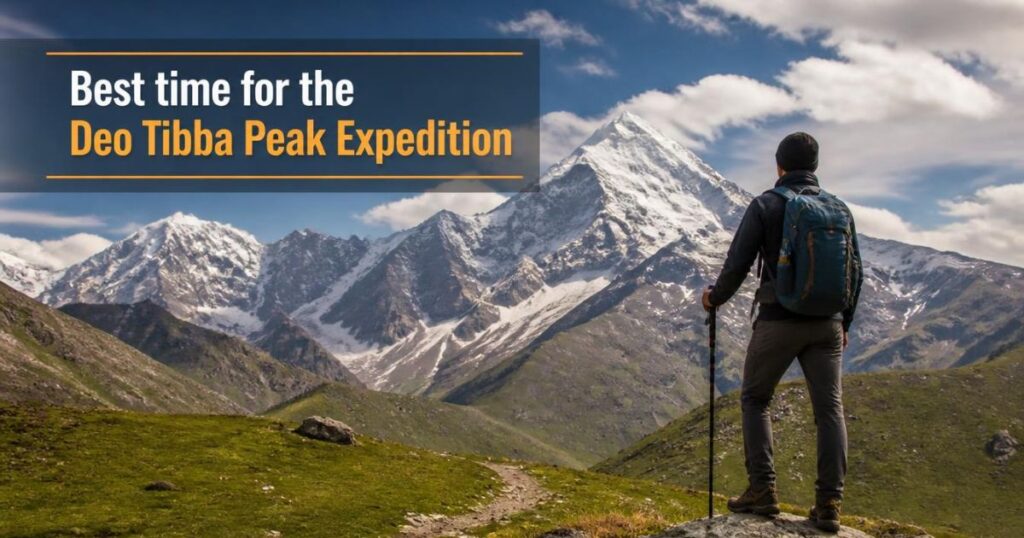
The two main windows are May to June and September to October, when skies are usually clearer and drier.
- May–June: More snow on the upper slopes, and more teams on the mountain.
- September–October: Less snow and colder nights. The window closes early as winter approaches.
It is late October 2026 as I write this, so this season is nearly over. Most climbers will realistically plan for May–June 2027. Check weather forecasts with your operator before booking, because conditions shift fast at altitude.
Even in good seasons, the weather can turn. The Navy team faced whiteouts, heavy snowfall and strong winds on its summit push.
Permits and rules
The expedition needs a permit. The climb is regulated by the Indian Mountaineering Foundation (IMF), so check the official Indian Mountaineering Foundation website for current peak rules and fees. Fees differ for Indian and foreign climbers, and they change over time. Do not rely on old blog posts for permit costs.
Most climbers book through a registered operator that handles permits, guides, food and camp gear. That is the simplest route for first-time 6,000 m climbers.
How much does it cost?
One registered operator lists the expedition at ₹64,500 per person. Prices vary by operator, group size and inclusions. Before you pay, ask what the fee covers:
- Permits and camping fees
- Technical gear (ropes, harness, crampons, ice axe)
- Guides and support staff
- Meals and tents
- Transport from Manali
Personal gear, travel to Manali and insurance often cost extra.
Who should attempt it?
Good fit:
- Trekkers who have done high-altitude routes and want a first technical summit
- Climbers training for harder peaks (some operators call it a stepping stone)
Poor fit:
- Beginners with no snow or rope experience
- Anyone who has not trained for sustained effort above 5,000 m
Common mistakes include arriving underprepared on fitness, skipping acclimatization and underestimating weather. A short basic mountaineering course before booking will help a great deal.
What to pack
Your operator will send a full list. At minimum, expect:
- Insulated mountaineering boots and layered clothing
- Waterproof shell, gloves and a warm hat
- Sunglasses and strong sunscreen for snow glare
- Personal medicines and a basic first-aid kit
- Water bottles and a sleeping bag rated for sub-zero nights
Technical gear such as crampons, helmets and ice axes are often supplied. Confirm this in advance.
Pair it with other Himachal trips
Many climbers add a few relaxed days in Himachal before or after the climb to rest and adjust. If you want a quieter village stay in Kullu district, read our Shangarh Himachal guide to the meadow village in Sainj Valley. For a different Himalayan region, our Chitkul travel guide for the Baspa Valley covers Kinnaur’s last village. You can find more mountain and destination ideas in our travel category.
Deo Tibba’s climbing history
Deo Tibba has drawn climbers for decades. In 1969, a group of 24 climbers from Turin ascended the peak, as recorded in The Himalayan Journal. More recently, expeditions have included the Navy’s women’s team in 2018, as documented on the Indian Navy website.
FAQ,s
How high is Deo Tibba?
Deo Tibba is about 6,001 m (19,688 ft) high. Some older sources list slightly different figures, such as 6,004 m, so expect small variations.
How difficult is the Deo Tibba Peak Expedition?
It is challenging and technical. Climbers need to use ropes, crampons and ice axes, and weather can change quickly. Beginners without any snow experience should train first.
What is the best time for the Deo Tibba Peak Expedition?
May to June and September to October are the usual windows. For most climbers in late 2026, May–June 2027 is the next practical option.
How many days does the expedition take?
One operator plans 13 days from Manali and back. Your trip may run longer if weather delays the summit day.
Do I need a permit?
Yes. The expedition is regulated by the Indian Mountaineering Foundation. Registered operators usually arrange the paperwork, but verify current rules on the IMF website.
Conclusion
The Deo Tibba Peak Expedition suits climbers who want a serious but approachable 6,000 m summit in the Himachal Himalaya. The route from Manali through Chhikka and Seri, past camps above 4,000 m and up an ice dome, rewards preparation and patience. It punishes shortcuts, especially on acclimatization and weather judgment.
Before you commit, confirm the permit, price inclusions and season with a registered operator. Train for sustained effort at altitude, and pick your dates carefully. With the right preparation, Deo Tibba is a strong first step toward bigger Himalayan climbs.
