
Everest Base Camp (EBC) on the Nepal side sits at 5,364 meters (17,598 feet) above sea level. Most trekkers start walking at Lukla, 2,860 m (9,383 ft), so the trail climbs about 2,500 m in total. The numbers matter less than the pace. This Everest Base Camp altitude guide shows the height of every major stop, explains what thin air does to your body, and lays out a safe acclimatization plan for 2026.
Time-sensitive details (permits, insurance rules, flight operations) change often. Check them with your trekking operator or official Nepal sources before departure.
How High Is Everest Base Camp?
Everest Base Camp in Nepal is 5,364 m (17,598 ft) high. That is about 61% of the height of Everest’s summit (8,849 m).
The camp sits on the Khumbu Glacier inside Sagarmatha National Park. A second base camp exists on the Tibet side at roughly 5,150 m. This guide covers the Nepal (south) side, which almost every trekker visits.
Everest Base Camp Altitude Quick Facts
| Fact | Detail |
| Base Camp altitude (Nepal side) | 5,364 m / 17,598 ft |
| Tibet-side base camp | About 5,150 m |
| Starting point (Lukla) | 2,860 m / 9,383 ft |
| Total altitude gain, Lukla to EBC | About 2,504 m / 8,215 ft |
| Highest sleeping point | Gorak Shep, about 5,164 m |
| Highest trekking viewpoint | Kala Patthar, about 5,545 m |
| Usual trek length | 12 to 14 days with acclimatization days |
| Common seasons | March to May and September to November |
Everest Base Camp Altitude in Feet and Meters
- Meters: 5,364 m
- Feet: 17,598 ft
- Miles: about 3.33 miles above sea level
Published figures vary by a few meters between sources because of different survey methods. Most trekking companies and guidebooks use 5,364 m. Expect small differences, especially for villages and viewpoints.
What Is the Highest Point on the Everest Base Camp Trek?
Kala Patthar is the highest point most trekkers reach. Most sources list it at about 5,545 m (18,192 ft). Some measurements give 5,644 m (18,519 ft), so you will see both numbers online.
Base Camp itself is not the high point of the trek. Trekkers sleep lower, at Gorak Shep, and climb Kala Patthar early in the morning.
Why Kala Patthar Is Special
Kala Patthar gives you what Base Camp cannot: a clear view of Everest’s summit. At Base Camp, the neighboring peak Nuptse and the surrounding ridges block the top of the mountain. From Kala Patthar, Everest rises above them.
The climb is short but hard. You gain roughly 380 m from Gorak Shep, and you do it at more than 5,100 m, so every step feels slow. Most groups leave before sunrise for clear skies and softer light.
Everest Base Camp Altitude Chart
Use this chart to see where you sleep each night. Heights are approximate, and different guidebooks vary by 30 to 120 m.
| Stop | Altitude (m) | Altitude (ft) | Note |
| Lukla | 2,860 | 9,383 | Flight arrival |
| Phakding | 2,610 | 8,563 | Lower first night |
| Namche Bazaar | 3,440 | 11,286 | Acclimatization day |
| Tengboche | 3,860 | 12,664 | Monastery stop |
| Dingboche | 4,410 | 14,468 | Acclimatization day |
| Lobuche | 4,910 | 16,109 | Cold, thin air |
| Gorak Shep | 5,164 | 16,942 | Highest sleeping point |
| Everest Base Camp | 5,364 | 17,598 | Day trip from Gorak Shep |
| Kala Patthar | 5,545 | 18,192 | Sunrise viewpoint |
The jump from Phakding to Namche is about 830 m. That is more than the 500 m a day that doctors recommend above 3,000 m. This is why the Namche rest day exists.
The Science of Thin Air: Oxygen Levels at Everest Base Camp
Oxygen makes up about 21% of the air at every height. What changes is air pressure. At Base Camp, the pressure is roughly half of what you feel at sea level, so each breath delivers about half as much oxygen.
Your body responds in four ways:
- You breathe faster and deeper.
- Your heart rate rises.
- Your kidneys adjust your blood chemistry over several days.
- Your body slowly makes more red blood cells over weeks.
These changes need time. If you climb faster than your body adapts, altitude illness can follow.
When Does Altitude Sickness Start on the EBC Trek?
Altitude sickness can start from about 2,500 m, which means Namche Bazaar (3,440 m) is the first real test. Symptoms usually appear 6 to 12 hours after you reach a new sleeping height, although some people feel them sooner.
Risk rises as the trail climbs. Most trekkers who struggle do so between Namche and Dingboche, or on the push to Lobuche and Gorak Shep.
Doctors give two simple rules for sleeping altitude above 3,000 m:
- Gain no more than 500 m of sleeping altitude per day.
- Add an extra rest night for every 1,000 m you climb.
The CDC Yellow Book guidance on high-altitude travel and altitude illness explains these rules, which come from the Wilderness Medical Society. The height where you sleep matters more than the highest point you visit during the day.
The Three Forms of High-Altitude Illness Explained
| Illness | Affects | Key warning signs | Action |
| AMS | Whole body | Headache, nausea, tiredness, dizziness, poor sleep | Stop climbing; rest; descend if worse |
| HAPE | Lungs | Breathless at rest, wet cough, pink or frothy sputum, severe weakness | Descend now; seek medical help |
| HACE | Brain | Confusion, stumbling, odd behavior, extreme drowsiness | Emergency; descend immediately |
Acute Mountain Sickness (AMS)
AMS is the mildest and most common form. It feels like a bad hangover: a headache plus nausea, loss of appetite, dizziness, or unusual tiredness.
Mild AMS often settles after a rest day at the same height. Do not climb higher while you have symptoms. If symptoms get worse, go down.
High Altitude Pulmonary Edema (HAPE)
HAPE means fluid collects in the lungs. Trekkers notice they cannot catch their breath while resting. A dry cough may turn wet, and some people cough up pink, frothy fluid. Blue lips, chest tightness, and a sharp drop in walking strength are also warning signs.
HAPE can become life-threatening within hours. The treatment is descent, medical care, and oxygen when available.
High Altitude Cerebral Edema (HACE)
HACE means the brain swells. The classic early sign is poor balance. A person cannot walk a straight line, heel to toe. Confusion, strange behavior, and heavy drowsiness follow.
Untreated HACE can kill within 12 to 24 hours. Treat any mix of AMS symptoms plus confusion or loss of balance as an emergency.
Understanding Pulse Oximeter Readings on the EBC Trek
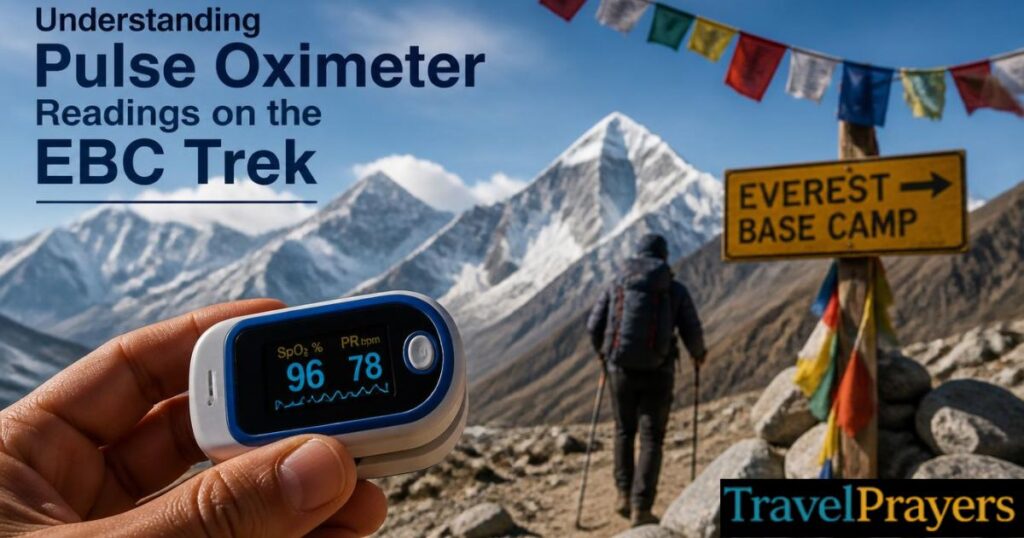
A pulse oximeter measures the percentage of oxygen in your blood (SpO2). At sea level, a healthy reading is usually 94 to 99%.
At altitude, healthy trekkers read much lower. A 2021 study of 319 trekkers at about 5,300 m recorded average resting readings near 79%. Trekkers with AMS averaged a little lower, around 76 to 77%.
Use your device the right way:
- Compare with your own baseline. Take readings at the same time each day, such as after waking, while seated and warm.
- Watch the trend. A steady fall, or a number far below your group’s, deserves attention.
- Treat the number as one clue. Cold fingers and movement can produce false readings. Medical guidelines do not diagnose altitude illness by a single SpO2 number.
- Trust symptoms first. A person with a headache, confusion, or breathlessness at rest needs help even if the number looks acceptable.
Never let a guide or a device alone talk you into, or out of, descent. Ask the guide to explain the reading.
Why Acclimatization Days Matter
Acclimatization days give your body time to adjust without climbing higher. On an acclimatization day, you stay at the same sleeping height and take a short walk higher, then return to sleep. Trekkers call this “climb high, sleep low.”
Trekkers who skip these days do not get stronger. They often get sick, then lose far more time than a rest day would have cost. Fitness helps you walk, but it does not speed up acclimatization.
Namche Bazaar Acclimatization Day
Namche Bazaar (3,440 m) is the first rest stop, and it follows the biggest sleeping-altitude jump of the trek. A common day hike goes to the Everest View Hotel, around 3,880 m, which gives your first distant look at Everest and Ama Dablam. Others walk to Khumjung village.
Walk slowly. Drink water, eat well, and return to Namche to sleep. Namche also has pharmacies, bakeries, and gear shops, so check your equipment here.
Dingboche Acclimatization Day
Dingboche (about 4,410 m) is the second rest stop, and many trekkers find it harder than Namche. The air is colder and drier, and sleep gets worse.
Popular day hikes include Nagarjun Hill, at around 5,000 m, and the trail toward Chhukung. Climb to a height above your sleeping point, rest briefly, then come back down. Sleeping below your high point is what builds adaptation.
Why High-Altitude Insurance Matters
Standard travel insurance often excludes trekking above a certain height. A rescue from the upper Khumbu can cost thousands of dollars, and you cannot buy cover once you feel sick. Buy the policy before you fly.
What Your Insurance Should Cover
Check the policy wording for these points:
- Trekking up to at least 6,000 m, which covers Kala Patthar
- Emergency helicopter evacuation, not only “medical transport”
- Hospital treatment in Nepal
- Trip delay and cancellation, since Lukla flights often face weather delays
- Whether you must call the insurer first, and how to reach its emergency line
Keep the insurer’s 24-hour number, your policy number, and a copy of the policy in your phone and with your guide.
The Reality of Helicopter Evacuations on the EBC Trek
Helicopter rescue is a real safety net, and some trekkers need it. But you should know about a problem that has hurt trust in the system.
Nepal’s Central Investigation Bureau has investigated a large scheme involving fake or exaggerated rescues in trekking areas. Police have said that operators, helicopter companies, and hospitals filed inflated insurance claims, and dozens of people were charged in 2026. Some trekkers also reported pressure to evacuate when they felt better. The Wilderness Medical Society explains how trekkers can protect themselves and why genuine evacuations still matter.
Protect yourself in practical ways:
- Ask the guide to explain why evacuation is needed and show you the pulse oximeter reading.
- Request a second opinion from the Himalayan Rescue Association aid post, where one is available on your route.
- Call your insurer yourself before you agree to a flight.
- Keep records of symptoms, readings, and names.
- Never refuse an evacuation if you show signs of HAPE or HACE. A real emergency comes first.
What Is the Khumbu Cough?
The Khumbu cough is a dry, persistent cough that many trekkers develop above about 4,000 m. Cold, dry air irritates the throat and airways, and heavy breathing makes it worse. Dust on the trail adds to the problem.
Common Symptoms
- A dry, hacking cough that often gets worse at night
- A sore, scratchy throat
- Chest or rib soreness after long coughing spells
- Hoarse voice
How to Reduce the Risk
- Cover your nose and mouth with a buff, especially in the cold morning and evening.
- Breathe through your nose when you can.
- Drink warm fluids often. Ginger or lemon tea works well in teahouses.
- Suck on throat lozenges.
- Avoid dusty sections without a mask.
See a doctor if you have fever, green or bloody sputum, or breathlessness at rest. Those signs point to infection, HAPE, or another problem, not a simple cough.
Why Do Trekkers Wake Up Gasping for Air?
Waking up gasping at night is common above about 3,500 m and usually comes from periodic breathing, not from danger.
What Happens?
At altitude, your breathing becomes uneven during sleep. You take several deep breaths, then pause for a few seconds, then breathe again. The pause can drop your oxygen level just enough to wake you with a gasp or a feeling of suffocation.
Is It Dangerous?
Usually not. It often eases as you acclimatize. Treat it as a warning sign if you also have a headache that does not ease, a wet cough, breathlessness while awake and resting, or confusion. Sleep with your head slightly raised, avoid alcohol and sleeping pills, and tell your guide.
What Is Diamox?
Diamox is a brand name for acetazolamide, a prescription medicine that helps your body acclimatize faster. It makes you breathe a little deeper, which raises blood oxygen. It also reduces periodic breathing at night.
For prevention, the Wilderness Medical Society guideline gives an adult dose of 125 mg every 12 hours, usually started the day before you ascend. Your doctor sets the dose for you.
Important Things to Know
- It supports slow ascent; it does not replace it. Walking too fast with Diamox still causes problems.
- Common side effects: tingling in the fingers and toes, more frequent urination, and a strange taste with fizzy drinks.
- Allergy risk: Tell your doctor if you have a sulfa allergy, kidney or liver disease, or other conditions.
- It does not treat HAPE. Descent and medical care come first.
- Get advice before you leave home. Do not try it for the first time on the trail.
Everest Base Camp vs Annapurna Base Camp Altitude
Everest Base Camp is higher than Annapurna Base Camp by 1,234 m. Annapurna Base Camp (ABC) sits at 4,130 m (13,550 ft), while EBC reaches 5,364 m.
| Feature | Everest Base Camp | Annapurna Base Camp |
| Altitude | 5,364 m / 17,598 ft | 4,130 m / 13,550 ft |
| Highest viewpoint | Kala Patthar, about 5,545 m | Base Camp itself |
| Highest sleeping altitude | About 5,164 m (Gorak Shep) | About 4,130 m |
| Typical duration | 12 to 14 days | About 7 to 10 days |
| Altitude sickness risk | Higher | Lower, but still real |
| Best for | Trekkers with time and a high-altitude goal | First-time Himalayan trekkers; shorter trips |
ABC suits trekkers with limited time or worries about altitude. EBC suits people who can spend two weeks and want to sleep above 5,000 m. Neither trek is safe if you rush.
Everest Base Camp Altitude Compared to Other Famous Destinations
| Destination | Altitude | How it compares with EBC |
| Machu Picchu, Peru | About 2,430 m | EBC is about 2,900 m higher |
| Chitkul, India | About 3,450 m | EBC is about 1,900 m higher |
| Jispa, India | About 3,200 m | EBC is about 2,150 m higher |
| Leh, India | About 3,500 m | EBC is about 1,860 m higher |
| Mont Blanc summit, France | 4,806 m | EBC is about 560 m higher |
| Deo Tibba, India | 6,001 m | Peak is about 640 m higher than EBC |
| Mount Kilimanjaro (Uhuru Peak) | 5,895 m | Peak is about 530 m higher than EBC |
| Mount Everest summit | 8,849 m | Summit is about 3,485 m higher than EBC |
If you want practice at height before Nepal, a few days in Himachal can help. Our guides to Chitkul and Jispa show how a 3,200 to 3,450 m stay feels. For a bigger challenge, read about the Deo Tibba Peak Expedition, a 6,001 m climb. Short stays at moderate altitude do not guarantee protection on EBC, but they teach you how your body behaves.
Essential Gear for High Altitude Trekking
Cold and dryness make altitude harder, so gear matters.
- Layers: Thermal base layer, fleece, insulated down jacket, and a waterproof shell
- Sleeping bag: A warm bag rated to about -15°C, because teahouse rooms are unheated
- Footwear: Broken-in waterproof boots and warm socks; add microspikes in cold or icy months
- Trekking poles: They reduce knee strain on long descents
- Sun protection: UV-rated sunglasses, high-SPF sunscreen, lip balm, and a hat
- Face cover: A buff or mask for dust and the Khumbu cough
- Water system: Two bottles and purification tablets or a filter
- Medical kit: Painkillers, rehydration salts, blister care, throat lozenges, and any medicine your doctor prescribes
- Pulse oximeter: Optional, but useful for tracking trends when you know its limits
- Power bank: Cold drains batteries fast
Final Thoughts
The Everest Base Camp Altitude Guide comes down to one number and one habit. The number is 5,364 m, the height of Base Camp. The habit is moving slowly enough that your body can follow.
Plan a 12 to 14 day itinerary with rest days at Namche Bazaar and Dingboche. Learn the signs of AMS, HAPE, and HACE before you leave home, and tell your guide about every symptom. Buy insurance that covers helicopter evacuation, and talk to your doctor about Diamox well in advance. Finally, accept that turning back is a good decision, not a failure.
For more mountain travel ideas, browse the travel category on TravelPrayers.
Frequently Asked Questions
How high is Everest Base Camp?
Everest Base Camp on the Nepal side is 5,364 m (17,598 ft) above sea level. The Tibet-side base camp is lower, at about 5,150 m. Trekkers start at Lukla (2,860 m), so they climb roughly 2,500 m over the trek.
What is the highest point on the Everest Base Camp trek?
Kala Patthar is the highest point on the standard trek, at about 5,545 m (18,192 ft). Some measurements list it at 5,644 m. You can see Everest’s summit from there, but you cannot see the full summit from Base Camp.
At what altitude does altitude sickness start on the EBC trek?
Altitude sickness can begin from about 2,500 m, and many trekkers first notice it near Namche Bazaar (3,440 m). Symptoms usually start 6 to 12 hours after you reach a new sleeping height. The risk rises sharply above 4,000 m.
Is Everest Base Camp safe for beginners?
Beginners can complete the trek, but it is not risk-free. You do not need climbing skills, but you need good walking fitness, a slow pace, and a plan for altitude illness. Choose an itinerary with rest days, carry insurance that covers helicopter evacuation, and walk with a licensed guide.
How many acclimatization days are needed for Everest Base Camp?
Most itineraries include two acclimatization days, one at Namche Bazaar and one at Dingboche. Doctors recommend an extra rest night for every 1,000 m of sleeping altitude gained above 3,000 m. Trekkers who feel unwell may need an extra day, so add buffer time.
